Monday, December 5, 2011

From: Taxidermy.net
What is Taxidermy?
 Themodern practice of taxidermy incorporates many crafts, such as carpentry,woodworking, tanning, molding and casting; but it also requires artistictalent, including the art of sculpture, painting and drawing. In a moderndeer head mount, for example, the only natural parts of the animal usedare the antlers and the skin. All of the other organs and tissues are recreatedwith man-made materials. The eyes are made from glass, the eyelids aresculpted from clay, the soft tissues of the nose and mouth are sculptedfrom epoxy or wax, and the mannikin or "form" (which incorporatesthe anatomy of each muscle and vein) is made from polyurethane foam.
 Today,some taxidermy mounts (most notably saltwater fish) do not contain anyparts of the animal at all. They are completely re-created from man-madematerials. This is ideal for catch-and-release anglers, who can releasetheir gamefish unharmed, and can still have a life-sized trophy producedfrom a good color photo and measurements.
Taxidermy is a general term describingthe many methods of reproducing a life-like three-dimensional representationof an animal for permanent display. In some cases, the actual skin (includingthe fur, feathers or scales) of the specimen is preserved and mounted overan artificial armature. In other cases, the specimen is reproduced completelywith man-made materials.
The word "taxidermy" isderived from two ancient Greek words; taxis, meaning movement; andderma, meaning skin. Therefore, loosely translated, taxidermy meansthe movement of skin. This is a fairly appropriate definition as many taxidermyprocedures involve removing the natural skin from the specimen, replacingthis skin over an artificial body, and adjusting the skin until it appearslifelike.
Themodern practice of taxidermy incorporates many crafts, such as carpentry,woodworking, tanning, molding and casting; but it also requires artistictalent, including the art of sculpture, painting and drawing. In a moderndeer head mount, for example, the only natural parts of the animal usedare the antlers and the skin. All of the other organs and tissues are recreatedwith man-made materials. The eyes are made from glass, the eyelids aresculpted from clay, the soft tissues of the nose and mouth are sculptedfrom epoxy or wax, and the mannikin or "form" (which incorporatesthe anatomy of each muscle and vein) is made from polyurethane foam.Today,some taxidermy mounts (most notably saltwater fish) do not contain anyparts of the animal at all. They are completely re-created from man-madematerials. This is ideal for catch-and-release anglers, who can releasetheir gamefish unharmed, and can still have a life-sized trophy producedfrom a good color photo and measurements.Works of taxidermy are displayedin museums, educational institutions, businesses, restaurants, and homes.There are many different methods for producing mounts (or re-creations)of different species.
From: Werner Studio- Redefined Petah Coyne
Friday, January 23, 2009
Petah Coyne

On Wednesday, I drove down to Oklahoma City to hear an artist's talk by Petah Coyne, a very prominent contemporary artist from NYC. The talk was held at Untitled[ArtSpace], where they will be exhibiting Modern Materials, the art quilt exhibit I'm curating for next summer. Petah gave a delightful and insightful talk that made me realize that I don't necessarily think like some artists do.
When Petah was a younger artist, she had a compulsion for collecting dead fish and she used them to festoon the rafters of her NYC loft. After her husband developed an allergic sensitivity to them, she used the 5,000 fish to decorate other places instead. At one point, she discovered a charming home in Long Island and, in the middle of the night, strung lines through the trees outside the front door of the house, then hung a large number of the dead fish on the lines. She was so hurt the next day when the homeowner came outside and reacted negatively to the fish that decorated his front yard. To Petah, the fish were a great gift and she couldn't understand why the homeowner didn't love them the same way she did. As I have never collected dead fish or even decorated with one of them, I suspect that the left side of my brain must have a bigger hold on me than my artwork would suggest.
After the lecture, an extremely nice woman named Michi Susan took me out to dinner in The Paseo Art District, where she has a studio. She creates beautiful collaged artwork using paper. Not only did she pay for my food (I probably ate 95% of the calories between the two of us), but she also listened quite graciously to my incessant babbling. Afterward, we returned to the gallery and spent the night, along with Laura Warriner (the gallery founder) in the second floor bedrooms. What an amazing, art-filled place!
The next morning, we gathered up another woman and the four of us ate breakfast at a Guatamalan restaurant. The biggest surprise there was the way they prepared oatmeal. Imagine milk soup that has some oatmeal floating around in it. It was surpringly tasty, however.
After breakfast, we returned to the gallery and I had a planning session for Modern Materials with Laura, Jon Burris, (Executive Director), Jan Evans (Program Coordinator) and Autumn Daves (Development/PR Coordinator). We managed to get a lot done and, to help them with their work on the exhibit, I gave Jan and Autumn a couple of the cows that had wandered through the gallery model a while back. I hope that the cows bring them good luck and that the staff can save them from any future alien abductions.
From: Leslie Scalapino- About the Artist, Petah Coyne
ABOUT THE ARTIST, PETAH COYNE
In Untitled #1336 (Scalapino Nu Shu), 2009-2010, an apple tree covered in black sand is populated with taxidermy pheasants and peacocks. Peacocks were important to Flannery O’Connor, who wrote about and raised them, and saw them as symbols of renewal and the “eyes” of the Catholic Church. The peacocks in Coyne’s tree are brilliant, but rather than preening they seem strangely frozen in time, anticipating. This sense of waiting is embodied in Nu Shu, a centuries-old Chinese writing technique solely for women and used to secretly express loneliness and fear. Knowing this back story gives Coyne’s peacocks something to anticipate—a story told in secret writing to an intimate friend. The title of the work references Coyne’s own friendship with the poet Leslie Scalapino.—Denise Markonish, curator, MASS MoCA, North Adams, MAPetah Coyne
Untitled # 1336 (Scalapino Nu Shu), 2009–2010
Apple tree, taxidermy Black Melinistic Pheasants, taxidermy Blue India Peacocks, taxidermy Black-Shouldered Peacocks, taxidermy Spaulding Peacocks, black sand from pig iron casting, Acrylex 234, black paint, cement, chicken wire fencing, wood, gravel, sisal, staging rope, cotton rope, insulated foam sealant, pipe, epoxy, threaded rod, wire, screws, jaw-to-jaw swivels
158 x 264 x 288 inches (401.3 x 670.6 x 731.5 cm)
Collection: Kemper Museum of Contemporary Art, Kansas City, Missouri
© Petah Coyne
Courtesy Galerie Lelong, New York
Photo © Elisabeth Bernstein

From: Berkshire Fine Arts- Petah Coyne at MASS MoCA
Petah Coyne at Mass MoCA
Exhibition Opens May 29
By: Ariel Petrova - 05/04/2010
A new work by Petah Coyne will be on view at Mass MoCA opening on May 29.
Viewers will be transported when entering the MASS MoCA galleries this summer. Petah Coyne's baroque works, delicately combining tinted, waxed flowers and taxidermy, will rise up from the floor, and hanging sculptures will descend from the ceiling, taking full advantage of the multiple vantage points of MASS MoCA's vast gallery spaces. The exhibition titled Everything That Rises Must Converge (after a short story by Flannery O'Connor) will open on Saturday, May 29, with an opening reception from 5-7 PM.
A selection of Coyne's work from the past two decades, along with two new works, will be on view at MASS MoCA. As a sculptor, Coyne has been an important presence in the international contemporary art scene since the 1980s. At a time when conceptualism in art reigned supreme, Coyne was never afraid to bring an overabundance of beauty alongside meaning in her work. MASS MoCA is proud to present her largest retrospective of works to date including her two most recent sculptures, showcasing for a wide audience the impact of Coyne's diverse works.
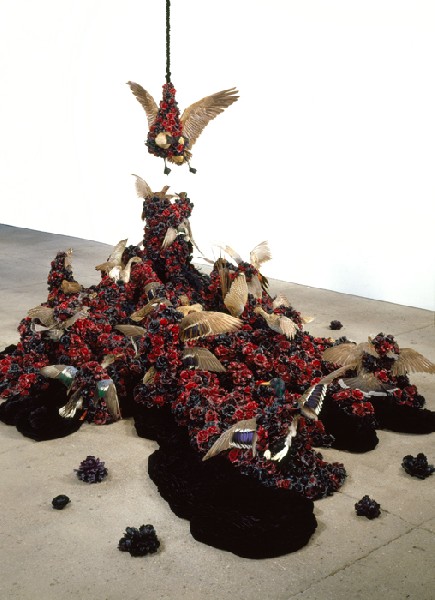
The works in this exhibition begin with Coyne's sculptures from the late 1980s, when the artist shifted from organic materials (straw, mud and fish) to metal and black sand (a by-product of pig iron casting). Works like Whirlwind (1989) seem to spin in front of the viewer, referencing flowing forms despite their material heaviness. In addition to these mid-career works, selections from Coyne's latest series based on Dante's Inferno will be on view. Central to this series is Untitled #1180 (Beatrice) which transforms Dante's love into a monumental sculpture of silk flowers dipped in black wax, subtly colored, as well as velvet and taxidermy birds diving in and out of the towering form.
Much of Coyne's work references literature, including Sawako Ariyoshi's The Doctor's Wifeand Yasunari Kawabata's House of the Sleeping Beauties, and films like Michelangelo Antonioni's La Notte and Luchino Visconti's Death in Venice. The writings of Flannery O'Connor are a continual influence on Coyne's recent work, both for their Catholic symbolism and beautiful darkness. This is particularly evident in Coyne's two new works for the exhibition. Untitled #1176 (Elisabeth-Elizabeth) is made of exotic Chinese and South American pheasants, silk flowers and black wax and will hang high in the gallery. Coyne's other new work, the centerpiece of the exhibition, is Untitled #1336 (Scalapino Nu Shu), a 14-foot tall craggy apple tree, covered in black sand and seventeen hanging pheasants. Perched above the pheasants at the top of the tree are ten peacocks waiting to take flight.
The peacock is rich in references, both for the artist and throughout history. Peacocks are a Christian symbol of immortality, renewal and transformation, and are known as the "eyes" of the Catholic Church. Prized for their beauty, they were a bird that O'Connor loyally raised, lived with, and wrote about. The title of the work also references nu shu which is a centuries-old secret writing taught to pairs of young Chinese women so that they could communicate over their lifetimes, often across great differences. The added reference to Leslie Scalapino, a poet and friend of the artist, speaks of a similarly special bond between two women.
An entire section of the exhibition will be dedicated to Coyne's seldom exhibited photography - enchanting explorations of movement and tone. Upon first glance they seem to be black and white but just as the colors of flowers emerge from the black wax works, here subtle shades poke through these blurred figures of children, Buddhist monks, and brides. Unlike many contemporary artists who focus on social or media-related issues, Petah Coyne imbues her work with a magical quality to evoke intensely personal associations. Her sculptures convey an inherent tension between vulnerability and aggression, innocence and seduction, beauty and decadence, and, ultimately, life and death. Coyne's work seems Victorian in its combination of an overloaded refinement with a distinctly decadent and morbid undercurrent. Her innovative use of materials includes dead fish, mud, sticks, black sand, shredded car parts, wax, satin ribbons, artificial flowers and birds, birdcages, taxidermy animals, Madonna statues, and horsehair.
Petah Coyne was born in Oklahoma City in 1953. She lives and works in New York and New Jersey . Recent solo exhibitions include Vermilion Fog at Galerie Lelong, NY; Petah Coyne: Above and Beneath the Skin organized by Albright-Knox Art Gallery, Buffalo, NY, traveling to Sculpture Center, Long Island City, NY, Chicago Cultural Center, Chicago, IL, Kemper Museum of Contemporary Art, Kansas City, MO, and Scottsdale Museum of Contemporary Art, Scottsdale, AZ; and Petah Coyne: Hairworks at Cincinnati Art Museum, Cincinnati, OH. Selected group exhibitions include Damaged Romanticism: A Mirror of Modern Emotionorganized by the Blaffer Gallery, University of Houston, Houston, TX, traveling to Grey Art Gallery, New York University, NY, and the Parrish Art Museum, Southampton, NY;Uncontained, Whitney Museum of American Art, New York, NY; and Material Actions, Museum of Contemporary Art, San Diego, CA. Coyne's work is in the collections of the Brooklyn Museum, Brooklyn, NY; Corcoran Gallery of Art, Washington, DC; National Gallery of Art, Washington, D.C.; Metropolitan Museum of Art, NY; Museum of Fine Arts, Boston, MA; Museum of Modern Art, NY; Philadelphia Museum of Art, Philadelphia, PA; Solomon R. Guggenheim Museum, NY; The Whitney Museum of American Art, NY, and many more. She is represented by Galerie Lelong , NY .
The exhibition will be accompanied by a catalog co-published by MASS MoCA and the Yale University Press. This unique book will feature color illustrations of the works in the exhibition as well as texts by exhibition curator Denise Markonish , an interview between the artist and cultural critic Rebecca Solnit, and a new piece of fiction by author A.M. Homes that places Coyne's work in the context of MASS MoCA's hometown, North Adams , Mass. The 128-page catalog will be available July 2, 2010.
A selection of Coyne's work from the past two decades, along with two new works, will be on view at MASS MoCA. As a sculptor, Coyne has been an important presence in the international contemporary art scene since the 1980s. At a time when conceptualism in art reigned supreme, Coyne was never afraid to bring an overabundance of beauty alongside meaning in her work. MASS MoCA is proud to present her largest retrospective of works to date including her two most recent sculptures, showcasing for a wide audience the impact of Coyne's diverse works.
The works in this exhibition begin with Coyne's sculptures from the late 1980s, when the artist shifted from organic materials (straw, mud and fish) to metal and black sand (a by-product of pig iron casting). Works like Whirlwind (1989) seem to spin in front of the viewer, referencing flowing forms despite their material heaviness. In addition to these mid-career works, selections from Coyne's latest series based on Dante's Inferno will be on view. Central to this series is Untitled #1180 (Beatrice) which transforms Dante's love into a monumental sculpture of silk flowers dipped in black wax, subtly colored, as well as velvet and taxidermy birds diving in and out of the towering form.
Much of Coyne's work references literature, including Sawako Ariyoshi's The Doctor's Wifeand Yasunari Kawabata's House of the Sleeping Beauties, and films like Michelangelo Antonioni's La Notte and Luchino Visconti's Death in Venice. The writings of Flannery O'Connor are a continual influence on Coyne's recent work, both for their Catholic symbolism and beautiful darkness. This is particularly evident in Coyne's two new works for the exhibition. Untitled #1176 (Elisabeth-Elizabeth) is made of exotic Chinese and South American pheasants, silk flowers and black wax and will hang high in the gallery. Coyne's other new work, the centerpiece of the exhibition, is Untitled #1336 (Scalapino Nu Shu), a 14-foot tall craggy apple tree, covered in black sand and seventeen hanging pheasants. Perched above the pheasants at the top of the tree are ten peacocks waiting to take flight.
The peacock is rich in references, both for the artist and throughout history. Peacocks are a Christian symbol of immortality, renewal and transformation, and are known as the "eyes" of the Catholic Church. Prized for their beauty, they were a bird that O'Connor loyally raised, lived with, and wrote about. The title of the work also references nu shu which is a centuries-old secret writing taught to pairs of young Chinese women so that they could communicate over their lifetimes, often across great differences. The added reference to Leslie Scalapino, a poet and friend of the artist, speaks of a similarly special bond between two women.
An entire section of the exhibition will be dedicated to Coyne's seldom exhibited photography - enchanting explorations of movement and tone. Upon first glance they seem to be black and white but just as the colors of flowers emerge from the black wax works, here subtle shades poke through these blurred figures of children, Buddhist monks, and brides. Unlike many contemporary artists who focus on social or media-related issues, Petah Coyne imbues her work with a magical quality to evoke intensely personal associations. Her sculptures convey an inherent tension between vulnerability and aggression, innocence and seduction, beauty and decadence, and, ultimately, life and death. Coyne's work seems Victorian in its combination of an overloaded refinement with a distinctly decadent and morbid undercurrent. Her innovative use of materials includes dead fish, mud, sticks, black sand, shredded car parts, wax, satin ribbons, artificial flowers and birds, birdcages, taxidermy animals, Madonna statues, and horsehair.
Petah Coyne was born in Oklahoma City in 1953. She lives and works in New York and New Jersey . Recent solo exhibitions include Vermilion Fog at Galerie Lelong, NY; Petah Coyne: Above and Beneath the Skin organized by Albright-Knox Art Gallery, Buffalo, NY, traveling to Sculpture Center, Long Island City, NY, Chicago Cultural Center, Chicago, IL, Kemper Museum of Contemporary Art, Kansas City, MO, and Scottsdale Museum of Contemporary Art, Scottsdale, AZ; and Petah Coyne: Hairworks at Cincinnati Art Museum, Cincinnati, OH. Selected group exhibitions include Damaged Romanticism: A Mirror of Modern Emotionorganized by the Blaffer Gallery, University of Houston, Houston, TX, traveling to Grey Art Gallery, New York University, NY, and the Parrish Art Museum, Southampton, NY;Uncontained, Whitney Museum of American Art, New York, NY; and Material Actions, Museum of Contemporary Art, San Diego, CA. Coyne's work is in the collections of the Brooklyn Museum, Brooklyn, NY; Corcoran Gallery of Art, Washington, DC; National Gallery of Art, Washington, D.C.; Metropolitan Museum of Art, NY; Museum of Fine Arts, Boston, MA; Museum of Modern Art, NY; Philadelphia Museum of Art, Philadelphia, PA; Solomon R. Guggenheim Museum, NY; The Whitney Museum of American Art, NY, and many more. She is represented by Galerie Lelong , NY .
The exhibition will be accompanied by a catalog co-published by MASS MoCA and the Yale University Press. This unique book will feature color illustrations of the works in the exhibition as well as texts by exhibition curator Denise Markonish , an interview between the artist and cultural critic Rebecca Solnit, and a new piece of fiction by author A.M. Homes that places Coyne's work in the context of MASS MoCA's hometown, North Adams , Mass. The 128-page catalog will be available July 2, 2010.
From: The MASS MoCA Blog
What’s on your soundtrack?

Our Education department installed a cork board in the lobby featuring changing questions about the galleries, exhibitions, etc. Our Education intern Kate wrote the following blog about the first question on the board and the answers we got.
Petah Coyne’s exhibition Everything that Rises Must Converge has attracted viewers across all audiences. How can we tell? A question board in MASS MoCA’s lobby recently displayed patron’s selections for a hypothetical soundtrack accompaniment.

Though it may be hard to imagine a soundtrack juxtaposing songs such as Big River by Johnny Cash with Maurice Ravel’s solo piano rendition of Gaspard de la Nuit, below are my personal favorite responses for the Petah Coyne soundtrack:
The Everything that Rises Must Converge soundtrack is only the first question on the feedback board for the summer. Stay tuned for future questions in the MASS MoCA lobby.
Petah Coyne’s exhibition Everything that Rises Must Converge has attracted viewers across all audiences. How can we tell? A question board in MASS MoCA’s lobby recently displayed patron’s selections for a hypothetical soundtrack accompaniment.
In many ways, all of us have personal soundtracks to our lives. With the innovation of MP3 players, particularly the iPod, it’s quite common to see someone out for a stroll casually bopping to their favorite tunes – whatever they may be. Curiously, the vast display of Petah Coyne’s artwork has evoked an equally vast musical response.
What’s interesting about these song selections is that in many ways they delineate the unique ways artwork has potential to move disparate audiences. Responses on the board eclipsed age differences and genres, spanning from Bach’s eighteenth century piano concertos, English rock hits such as Blackbird from the Beatles’ two-disc White Album, to contemporary singles by bands like The Postal Service, Smashing Pumpkins, and the artist Lady Gaga.Though it may be hard to imagine a soundtrack juxtaposing songs such as Big River by Johnny Cash with Maurice Ravel’s solo piano rendition of Gaspard de la Nuit, below are my personal favorite responses for the Petah Coyne soundtrack:


Posted July 12, 2010 by Brittany Bishop
Filed under Exhibitions, Interns, Petah Coyne
Leave a comment »
Filed under Exhibitions, Interns, Petah Coyne
Leave a comment »
What do you think?

Sebastian Smee from The Globe made our week with nice reviews of both Material World and the Petah Coyne exhibitions, saying, “MASS MoCA, the most consistently stimulating museum devoted to contemporary art in New England, has space to burn, making it the ideal place to show this kind of work. Material World: Sculpture to Environment, a group show devoted to large-scale, environment-altering installations made from cheap and plentiful materials, sees the museum playing to its strengths.”
And about Petah Coyne: Everything that Rises Must Converge, he said, “I admired the fearlessness of her aesthetic, which is the absolute antithesis of minimalist cool.”
Sebastian Smee from The Globe made our week with nice reviews of both Material World and the Petah Coyne exhibitions, saying, “MASS MoCA, the most consistently stimulating museum devoted to contemporary art in New England, has space to burn, making it the ideal place to show this kind of work. Material World: Sculpture to Environment, a group show devoted to large-scale, environment-altering installations made from cheap and plentiful materials, sees the museum playing to its strengths.”
And about Petah Coyne: Everything that Rises Must Converge, he said, “I admired the fearlessness of her aesthetic, which is the absolute antithesis of minimalist cool.”
Tuesday, November 29, 2011
From: Petah Coyne: Vermilion Fog at Galerie Lelong
Vermilion Fog
Presented by Galerie Lelong
October 24, 2008- December 13, 2008
Petah Coyne
|

Petah Coyne Vermilion Fog
October 24 – December 13, 2008
opening reception: Friday, October 24, 6 to 8 pm
Galerie Lelong presents 20 striking new sculptures by Petah Coyne in Vermilion Fog, an exhibition divided into two parts—Dante’s Inferno and Unforgiven, allusions to literature and film that loosely frame the works by themes of loss, chaos, and redemption. Vermilion Fog is a monumental exhibition for the artist known for her use of diverse materials in large works whose grace and fragility belie their immense weight and arduous process. Vermilion Fog opens to the public on Friday, October 24 from 6 to 8 pm, and the artist will be present.
The 20-year career of Petah Coyne has been one of constant and pervasive reinvention—the reinvention of her own working practices, of unconventional materials and their innate characteristics, of the delineations of figuration and abstraction. Coyne’s alchemic sensibilities have led her to adopt and interweave disparate and seemingly inflexible materials such as tree roots, sand, human hair, scrap metal, silk flowers, Velcro, religious statuary, and taxidermy. The labor-intensive works that result are both obsessively precise and wildly untamed. After all of her hoarding, hoisting, piling, wrestling, and encasing, Coyne’s creation is imbued with a restless energy that develops a life of its own.
Coyne incorporates past practices and makes a sweeping, audacious leap forward in Vermilion Fog, a significant exhibition for the artist. The narrative, hinted at in her previous sculptures, takes a more discernable form in the exhibition. Suspended in the air, sprawled on the floor, or winding skyward, the works appear frozen in time, halted. Tendrils dangling below or reaching out from the dense forms suggest decay, growth, and rebellion. In Dante’s Inferno, Coyne creates a haunting and alluring netherworld, with large, undulating masses of wax-dipped flowers, velvet, and branches in dark, saturated colors. The 11-foot Untitled #1180 (Beatrice), the centerpiece of Dante’s Inferno, is a towering, perilous creature with whole taxidermy birds engulfed in its grasp.
Stillness prevails in Unforgiven, where lush, rounded compositions of pale flowers and white doves represent a spiritual refuge. The artist envisions these suspended figures as souls ascending and descending, passing through the room. Exquisite, intricate gates of wax, flowers, and steel keep viewers at a distance from the works, emphasizing the sanctity of the space. Unforgiven is a moving finale for the exhibition from Coyne, whose themes of regeneration and renewal echo her own persistence and ingenuity as an artist.
Concurrently with Vermilion Fog, Petah Coyne’s works can be seen in three museum exhibitions: 21: Contemporary Art at the Brooklyn Museum in New York; Damaged Romanticism: A Mirror of Modern Emotion at the Blaffer Gallery, University of Houston; and Time/Frame, Spencer Museum of Art at the University of Kansas in Lawrence. Her work will be on view in the Art Museum of Western Virginia’s new building for their permanent collection, opening this fall. Petah Coyne is represented in numerous other museum collections, including the Metropolitan Museum of Art; Whitney Museum of American Art; Nasher Museum of Art; Corcoran Gallery of Art; High Museum of Art; and Museum of Contemporary Art Kiasma, Helsinki.
A catalogue featuring the works in Vermilion Fog and texts by Ann Wilson Lloyd and Leslie Scalapino is available, published by Charta Books and Galerie Lelong.
Hours: Tues - Sat, 10 am - 6 pm · Contact: Stephanie Joson, 212 315 0470 or stephanie@galerielelong.com
Subscribe to:
Posts (Atom)